Autonomic Nervous System (ANS)
Table of Contents
- Introduction
- Structural Architecture (The Two-Node Routing Chain)
- The Neurotransmission & Cotransmitter Protocol
- Central Integration & Control Hubs
- The System Output Matrix
- Clinical Relevance (Dental & Maxillofacial Context)
- Related Concepts
Introduction
- Concept: The involuntary division of the peripheral nervous system responsible for regulating visceral functions—such as heart rate, pupillary response, digestion, respiratory rate, salivation, and perspiration—without conscious or voluntary control. It functions continuously to maintain the internal homeostatic equilibrium of the body.
- The Analogy:
- Tech/CS: The System Kernel Daemons and Automated Resource Load Balancers.
- Explanation: If the Somatic Nervous System is the "User Space" GUI where every mouse click (voluntary muscle movement) runs an explicit command, the Autonomic Nervous System is the suite of underlying "Kernel Daemons" (like thermal throttling scripts, automated fan controls, and database clean-up cron jobs). It constantly monitors system telemetry—such as bus voltage (blood pressure), CPU thermal levels (body temperature), and background I/O storage throughput (gastrointestinal motility). It balances resources between two master performance profiles:
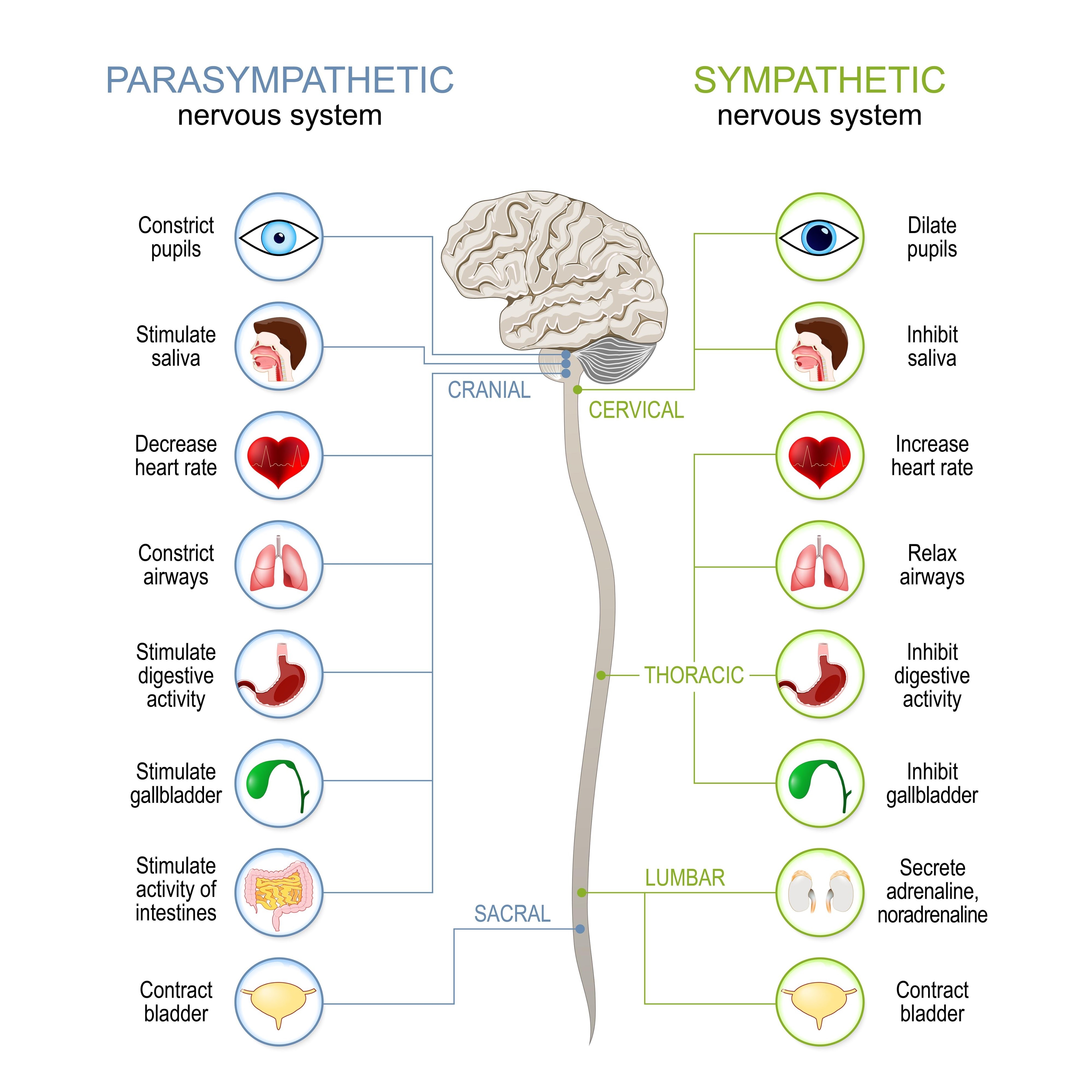
- Sympathetic (SANS): The "Overclocked / Threat-Mitigation" performance state (Fight-or-Flight). System resources are aggressively routed to processing cores (skeletal muscle, heart, lungs) while background storage cleanups (digestion, salivary flow) are paused.
- Parasympathetic (PANS): The "Low-Power / Rest-and-Maintenance" state (Rest-and-Digest). The system throttles back the main processing engines, charges the internal batteries, and flushes the database queues (digesting nutrients, clearing toxins, and generating protective salivary barriers).
Structural Architecture (The Two-Node Routing Chain)
With the exception of the adrenal medulla, the autonomic motor pathways utilize a highly standardized two-neuron chain to transmit command packets from the central nervous system (CNS) to the peripheral effector tissues.
- Preganglionic Neuron: Its cell body resides in the brainstem or spinal cord. Its myelinated axon (Type B fiber) exits the CNS to synapse at an autonomic ganglion.
- Autonomic Ganglion: The physical "Network Switch" or junction box where the preganglionic terminal hands off the signal to the next node.
- Postganglionic Neuron: An unmyelinated axon (Type C fiber) that originates in the ganglion and travels directly to the target effector organ.
The Anatomical Split
| Feature | Sympathetic Nervous System (SANS) | Parasympathetic Nervous System (PANS) |
|---|---|---|
| Outflow Origin | Thoracolumbar ( |
Craniosacral (Cranial nerves III, VII, IX, X; Sacral segments |
| Ganglia Location | Close to the spinal cord (Paravertebral chain or prevertebral ganglia). | Close to or directly within the target effector organ (Terminal/intramural ganglia). |
| Fiber Lengths | Short preganglionic fibers; Long postganglionic fibers. |
Long preganglionic fibers; Short postganglionic fibers. |
| Divergence Ratio | High ( |
Low ( |
The Neurotransmission & Cotransmitter Protocol
The system utilizes primary chemical signals alongside subtle secondary packets (cotransmitters) to execute fine-tuned, biphasic actions at the effector junctions:
- Ganglionic Synapse (Both Divisions): All preganglionic fibers release Acetylcholine (ACh), which binds to Nicotinic (
) receptors on the postganglionic cell membrane. This is a high-speed, ligand-gated ionotropic[1] channel that generates an instant depolarizing current. - Postganglionic Parasympathetic Effector: Releases ACh, which binds to metabotropic[2] Muscarinic (
to ) receptors on target tissues. - PANS Cotransmission: Often coreleases Vasoactive Intestinal Peptide (VIP) or Nitric Oxide (NO) (via nitrergic nerves) to facilitate prolonged, non-cholinergic vasodilation and enhance glandular output.
- Postganglionic Sympathetic Effector: Most release Norepinephrine (NE), which binds to metabotropic Adrenergic (
) receptors. - SANS Cotransmission: Coreleases Adenosine Triphosphate (ATP) for rapid, immediate smooth muscle contraction and Neuropeptide Y (NPY) for long-lasting, delayed vasoconstriction.
- System Exception: Sympathetic postganglionic fibers innervating eccrine sweat glands release ACh onto
receptors (sympathetic cholinergic pathway). - Adrenal Medulla Exception: Preganglionic sympathetic fibers bypass standard ganglia to synapse directly onto chromaffin cells inside the adrenal gland, triggering a direct release of Epinephrine (80%) and Norepinephrine (20%) into the bloodstream as hormones for global system overclocking.
Central Integration & Control Hubs
Autonomic execution is directed by higher-order processing nodes within the CNS:
- The Master Headquarters (Hypothalamus): Integrates autonomic, somatic, and endocrine responses.
- Posterior and Lateral Nuclei: Primarily regulate Sympathetic outputs (e.g., triggering fight-or-flight parameters during rage or fear).
- Anterior and Medial Nuclei: Primarily regulate Parasympathetic outputs.
- The Low-Level Processing Core (Brainstem): Houses vital cardiac, vasomotor, and respiratory centers in the medulla and pons. These networks handle automatic reflex loops, such as the baroreflex and respiratory-sinus arrhythmia.
- The User Interface Overlay (Cerebral Cortex & Limbic System): The prefrontal cortex and limbic loops route emotional contexts (anxiety, stage fright, anticipation) directly into the hypothalamus, shifting baseline autonomic tones before an action is even initiated (feedforward control).
The System Output Matrix
| Target Organ / Tissue | Sympathetic Action (Adrenergic) | Receptor | Parasympathetic Action (Cholinergic) | Receptor |
|---|---|---|---|---|
| Heart (SA Node / Myocardium) | Increased heart rate (chronotropy) & contractility (inotropy) | Decreased heart rate & conduction velocity | ||
| Arterioles (Skin, Mucosa, Viscera) | Vasoconstriction (restricts local peripheral blood flow) | Vasodilation (mostly indirect via endothelial NO release) | ||
| Arterioles (Skeletal Muscle) | Vasodilation (increases blood flow for flight) | Minimal to no direct effect | — | |
| Bronchiolar Smooth Muscle | Bronchodilation (maximizes oxygen intake) | Bronchoconstriction & increased mucus secretion | ||
| Gastrointestinal Tract | Decreased motility, sphincter contraction | Increased motility, sphincter relaxation | ||
| Urinary Bladder | Detrusor relaxation, sphincter contraction (urination lock) | Detrusor contraction, sphincter relaxation (micturition) | ||
| Iris Dilator / Sphincter Muscle | Mydriasis (pupillary dilation for far-vision focus) | Miosis (pupillary constriction) | ||
| Salivary Glands | Sparse, highly viscous, amylase-rich, sticky secretion | Profuse, thin, watery, enzyme-rich secretion |
Clinical Relevance (Dental & Maxillofacial Context)
1. The Salivary Gland Paradox (Dual Innervation)
- The Clinical Detail: Unlike most organs where PANS and SANS are direct, opposing physiological antagonists, the salivary glands are stimulated by both divisions, but the physical characteristics of the resulting saliva are vastly different.
- Parasympathetic (The Protective Fluid Barrier): PANS stimulation (via cranial nerves VII and IX acting on
receptors) drives a profuse, watery, bicarbonate-rich salivary flow. This fluid serves as the oral cavity's primary buffering system against acid-induced enamel demineralization. - Sympathetic (The Stress Dryness): SANS stimulation (acting via
and receptors) causes localized vasoconstriction of the gland's blood supply. The resulting saliva is highly viscous, concentrated, and rich in organic mucins and amylase, leading to the clinical sensation of a "dry, sticky mouth" when a patient is highly anxious in the dental chair.
- Parasympathetic (The Protective Fluid Barrier): PANS stimulation (via cranial nerves VII and IX acting on
- The Pharmacological Risk: Administering atropine-like drugs (anti-muscarinics) blocks the PANS
pathway, leaving the patient with severe Xerostomia (dry mouth), which destroys the protective oral defense layers and leads to a rapid spike in caries.
2. The Vasovagal Syncope Loop (System Crash)
- The Scenario: A highly anxious patient experiences intense pain or fear during the administration of a local anesthetic injection, triggering a sudden, uncoordinated autonomic reflex.
- The Loop: The cerebral cortex triggers a massive, sudden withdrawal of sympathetic tone combined with a profound vagal (parasympathetic) surge mediated by the vagus nerve (CN X).
- The Outcome: The hyper-active parasympathetic output triggers severe bradycardia (
activation) and widespread systemic vasodilation. Systemic blood pressure drops catastrophically, cerebral perfusion fails, and the patient temporarily loses consciousness (syncope) in the chair. - Dental Action: Lay the patient completely flat (Trendelenburg position) to allow gravity to restore blood flow to the brain, and support their airway until the autonomic daemons stabilize the blood pressure back to baseline.
3. Local Anesthetic Vasoconstriction (SANS Override)
- The Integration: To prolong the duration of local anesthesia and control hemorrhage, we add Epinephrine to local anesthetic cartridges (e.g., 2% Lidocaine with 1:100,000 Epinephrine).
- The Autonomic Mechanism: The injected epinephrine acts directly as an exogenous sympathetic agonist, binding to local vascular
receptors to cause intense vasoconstriction. - The Safety Protocol: If accidentally injected directly into a blood vessel (IV), this epinephrine payload can cause a transient, alarming sympathetic spike: severe tachycardia (
), hypertension ( ), palpitations, and intense anxiety. Always aspirate before injecting to confirm your needle is not in the vascular network.
4. Carotid Sinus Hypersensitivity (Hardware Sensor Overreaction)
- The Mechanism: The carotid sinus contains baroreceptors (stretch and pressure hardware sensors) that continuously monitor arterial pressure trends. In patients with Carotid Sinus Hypersensitivity, these sensors violently overreact to external, localized mechanical distortion.
- The Danger Node: If external pressure is applied to the neck (e.g., during extra-oral palpation of the carotid pulse, extreme head rotation in the chair, or rough retraction using dental mirrors near the angle of the mandible), the hyper-reactive baroreceptors falsely report a massive systemic hypertensive surge to the vasomotor center.
- The System Response: The brain immediately triggers an intense vagal dump to drop the heart rate and blood pressure substantially. This produces sudden presyncope or flatline syncope in the chair, requiring a quick response and potentially a permanent hardware fix (cardiac pacemaker intervention) if the condition is chronic and highly symptomatic.
Related Concepts
- Sympathetic Nervous System (SNS) (The dedicated overclocking pathway note)
- Parasympathetic Nervous System (PANS) (The routine maintenance division note)
- Enteric Nervous System (ENS) (The autonomous visceral coprocessor note)
- Suxamethonium (Succinylcholine) (The paralytic that acts on somatic nicotinic receptors, distinct from autonomic nicotinic receptors).
- Histamine (The chemical mediator that acts as a powerful vasodilator, mimicking a sudden parasympathetic-like vascular drop during anaphylaxis)
- Xerostomia (The clinical state of dry mouth caused by a failure of the parasympathetic secretory pathways)
- Epinephrine (The exogenous catecholamine that acts as an intensive SANS mimic)